Qi vs Qi2 vs MagSafe: What's the Difference? (2026)

Wireless charging has accumulated a confusing stack of labels. Here's what each one actually means, and — more usefully — when the differences are worth paying for and when they're marketing.
The four labels
Qi is the original open standard from the Wireless Power Consortium, around since 2010. No magnets. You place the phone on a pad and hope the coils line up. Speeds are modest: commonly 7.5W for iPhone, up to 15W for some Android devices. Misalignment is its defining weakness — a phone nudged off-centre charges slowly or not at all.
MagSafe is Apple's magnetic system, introduced with iPhone 12 in 2020. A ring of magnets in the phone snaps it into perfect coil alignment every time. That alignment is the actual innovation: better positioning means better efficiency, less waste heat, and higher safe speeds. Originally 15W; iPhone 16 and 17 models reach up to 25W with a 30W or better adapter.
Qi2 arrived in 2023 and is essentially MagSafe made open. Apple contributed its Magnetic Power Profile to the WPC, so Qi2 uses the same magnetic ring alignment and delivers a consistent 15W — to Android phones as well as iPhones. iPhone 13 and 14 gained Qi2 support with iOS 17.2; 15, 16 and 17 support it natively.
Qi2 25W (sometimes still called Qi2.2, finalized in 2025) raises the ceiling to 25W, matching MagSafe's current speed on the open standard.
The label that trips people up
There's a meaningful difference between "Made for MagSafe" and "MagSafe-compatible."
Made for MagSafe means Apple-certified, with the authentication chip that unlocks the top speeds. MagSafe-compatible means the accessory has the magnets and aligns correctly, but isn't running Apple's certification — so on an iPhone it typically charges at standard Qi rates rather than the 15W or 25W figure.
Both snap on and both work. They're priced differently for a reason, and it's worth knowing which you're buying rather than discovering it later.
So is Qi2 worth paying for?
Depends entirely on how you charge, and this is where most comparison articles stop being useful.
Yes, if you charge in bursts at a desk. Twenty minutes between meetings is exactly the window where the gap between 7.5W and 25W is the difference between a usable top-up and a rounding error. If your charger is at your desk and you're grabbing it constantly, buy the fastest certified thing you can.
Not really, if you charge overnight or while travelling. Eight hours is many times the time any phone needs at any of these speeds, and phones deliberately slow down near full anyway. Buying 25W for a hotel nightstand is buying a number you'll never observe.
For that second case the specs that actually change your experience are different ones: how thin it packs, whether the cable is attached or another thing to lose, whether it charges your watch and earbuds too, and whether it stays cool.
Two chargers, not one
The practical answer for most people is that a desk charger and a travel charger are different products with different jobs — and buying one device to do both means compromising on the job you do more often.
Optimize the desk one for speed. Optimize the travel one for what a hotel room actually demands: something flat, something that doesn't need a second cable, and something that handles the Apple Watch you'd otherwise pack a whole separate puck for.
Where OneSnap fits
OneSnap is the travel one.
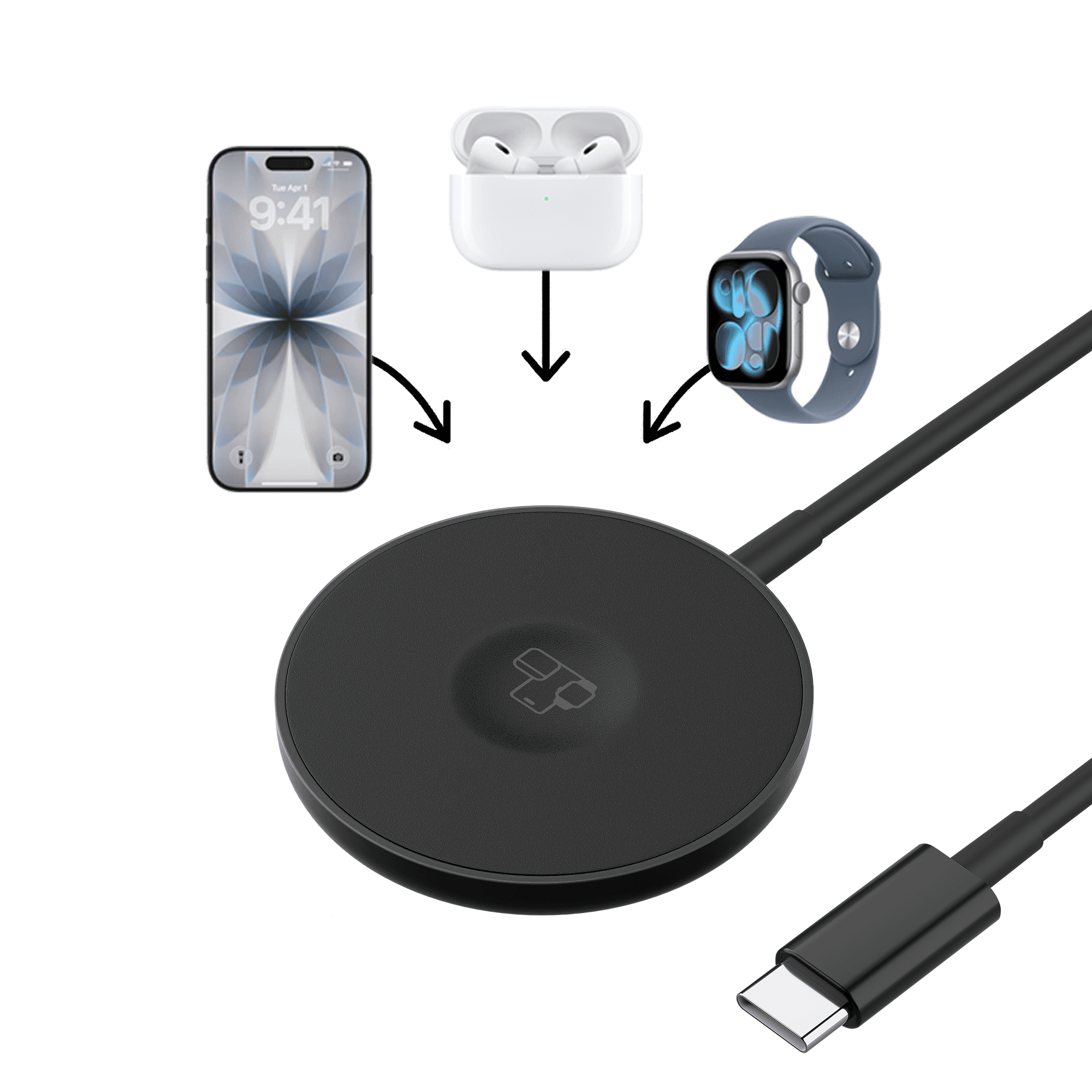
It's a single ultra-thin disc with a tethered 1m USB-C cable — no separate cable to forget, and nothing to hunt for in a bag. It charges your iPhone, Apple Watch, and AirPods from the one pad: the watch sits in the centre, which is unusual for a lie-flat charger and means one less puck in the suitcase. A silicone-coated surface keeps it from marking your phone, and it runs cool.
It ships with a UFO-shaped silicone travel case that the cable winds into, which is the difference between a charger that packs and one that tangles around everything else in the bag.
Wireless charging has accumulated a confusing stack of labels. Here's what each one actually means, and — more usefully — when the differences are worth paying for and when they're marketing.
The four labels
Qi is the original open standard from the Wireless Power Consortium, around since 2010. No magnets. You place the phone on a pad and hope the coils line up. Speeds are modest: commonly 7.5W for iPhone, up to 15W for some Android devices. Misalignment is its defining weakness — a phone nudged off-centre charges slowly or not at all.
MagSafe is Apple's magnetic system, introduced with iPhone 12 in 2020. A ring of magnets in the phone snaps it into perfect coil alignment every time. That alignment is the actual innovation: better positioning means better efficiency, less waste heat, and higher safe speeds. Originally 15W; iPhone 16 and 17 models reach up to 25W with a 30W or better adapter.
Qi2 arrived in 2023 and is essentially MagSafe made open. Apple contributed its Magnetic Power Profile to the WPC, so Qi2 uses the same magnetic ring alignment and delivers a consistent 15W — to Android phones as well as iPhones. iPhone 13 and 14 gained Qi2 support with iOS 17.2; 15, 16 and 17 support it natively.
Qi2 25W (sometimes still called Qi2.2, finalized in 2025) raises the ceiling to 25W, matching MagSafe's current speed on the open standard.
The label that trips people up
There's a meaningful difference between "Made for MagSafe" and "MagSafe-compatible."
Made for MagSafe means Apple-certified, with the authentication chip that unlocks the top speeds. MagSafe-compatible means the accessory has the magnets and aligns correctly, but isn't running Apple's certification — so on an iPhone it typically charges at standard Qi rates rather than the 15W or 25W figure.
Both snap on and both work. They're priced differently for a reason, and it's worth knowing which you're buying rather than discovering it later.
So is Qi2 worth paying for?
Depends entirely on how you charge, and this is where most comparison articles stop being useful.
Yes, if you charge in bursts at a desk. Twenty minutes between meetings is exactly the window where the gap between 7.5W and 25W is the difference between a usable top-up and a rounding error. If your charger is at your desk and you're grabbing it constantly, buy the fastest certified thing you can.
Not really, if you charge overnight or while travelling. Eight hours is many times the time any phone needs at any of these speeds, and phones deliberately slow down near full anyway. Buying 25W for a hotel nightstand is buying a number you'll never observe.
For that second case the specs that actually change your experience are different ones: how thin it packs, whether the cable is attached or another thing to lose, whether it charges your watch and earbuds too, and whether it stays cool.
Two chargers, not one
The practical answer for most people is that a desk charger and a travel charger are different products with different jobs — and buying one device to do both means compromising on the job you do more often.
Optimize the desk one for speed. Optimize the travel one for what a hotel room actually demands: something flat, something that doesn't need a second cable, and something that handles the Apple Watch you'd otherwise pack a whole separate puck for.
Where OneSnap fits
OneSnap is the travel one.
It's a single ultra-thin disc with a tethered 1m USB-C cable — no separate cable to forget, and nothing to hunt for in a bag. It charges your iPhone, Apple Watch, and AirPods from the one pad: the watch sits in the centre, which is unusual for a lie-flat charger and means one less puck in the suitcase. A silicone-coated surface keeps it from marking your phone, and it runs cool.
It ships with a UFO-shaped silicone travel case that the cable winds into, which is the difference between a charger that packs and one that tangles around everything else in the bag.
Related Articles
Check out our full product line
Check out our full product line

🇨🇦 A Canadian Company
© 2026 Futura Gear Inc. FTNT, the illustrated FTNT logo, and Footnote Accessories Co. are trademarks of Futura Gear Inc. All rights reserved.
© 2026 Futura Gear Inc. FTNT, the illustrated FTNT logo, and Footnote Accessories Co. are trademarks of Futura Gear Inc. All rights reserved.
🇨🇦 A Canadian Company