Find My Says "Nearby" But You Can't Find It? Here's Why

You open Find My. The map says your keys are here. You are standing in here. The keys are nowhere.
This is the most common frustration with item trackers and it isn't a malfunction. It's a structural gap between what tracking networks are good at and what finding an object actually requires — and the gap is roughly the last thirty feet.
What the network can and can't do
Find My works by having nearby Apple devices anonymously report a tag's Bluetooth signal. That's genuinely remarkable at continental scale: your keys can be located in a city you've never visited because strangers' iPhones passed near them.
But that report resolves to an area, not a point. Bluetooth doesn't measure distance precisely, GPS on the reporting device has its own error, and the position you see may be minutes or hours old — the last time any device happened to walk past. In practice a "nearby" pin can mean anywhere in a house, a parking row, or a stretch of trail.
The network is a locator, not a finder. It closes the first mile. It does not close the last thirty feet.
Sound closes some of that gap
The intended fix is Play Sound, and it works fine in a quiet living room. Where it fails is predictable:
Under and inside things. Couch cushions, a car seat crease, a packed bag, coat pockets, a laundry basket. Soft material absorbs high frequencies fast, and a buzzer under a cushion can be nearly inaudible from two metres.
Outdoors. Wind, traffic, and rain destroy a small speaker's range. In a parking lot, sound that carried ten metres indoors carries two.
In the cold. Batteries deliver less current at low temperature and small speakers get quieter — precisely in the season you're most likely to drop keys in a dark driveway.
When you can't localize it. Human hearing is poor at pinpointing a repeating electronic tone in a reverberant space. You can hear that it's somewhere in the garage and still spend five minutes finding it.
When it's dead. A tracker on a coin cell that quietly expired months ago makes no sound and reports nothing.
The five places this actually happens
The scenarios are remarkably consistent, and they share a feature:
The car footwell. Keys slide under the seat into a space with no light and a lot of sound absorption.
Grass, gravel, and snow. A driveway or lawn at night. The keys are within two metres and completely invisible.
Inside a bag. Somewhere in a backpack with eleven pockets.
Behind and under furniture. The gap between the couch and the wall.
The unlit walk itself. Not lost yet — just fumbling for the right key at a dark door, which is how the drop happens in the first place.
Four of five are dark. Three of five are also physically hard to see into. Sound was never going to solve those; you don't need to hear the keys, you need to see them.
What actually closes the last thirty feet
A visual alert on the object. A tracker that flashes rather than only beeping can be seen across a dark lawn from well beyond the distance you'd hear it.
A charge that doesn't quietly expire. Rechargeable beats a coin cell you forget about, because the failure mode of a coin cell is silence with no warning.
Something you'll actually keep on the keychain. The best tracker is the one that isn't in a drawer because it was too bulky or needed a separate holder.
Where FlashFinder fits
We built FlashFinder for exactly this gap — the network gets you close, and the light gets you the rest of the way.
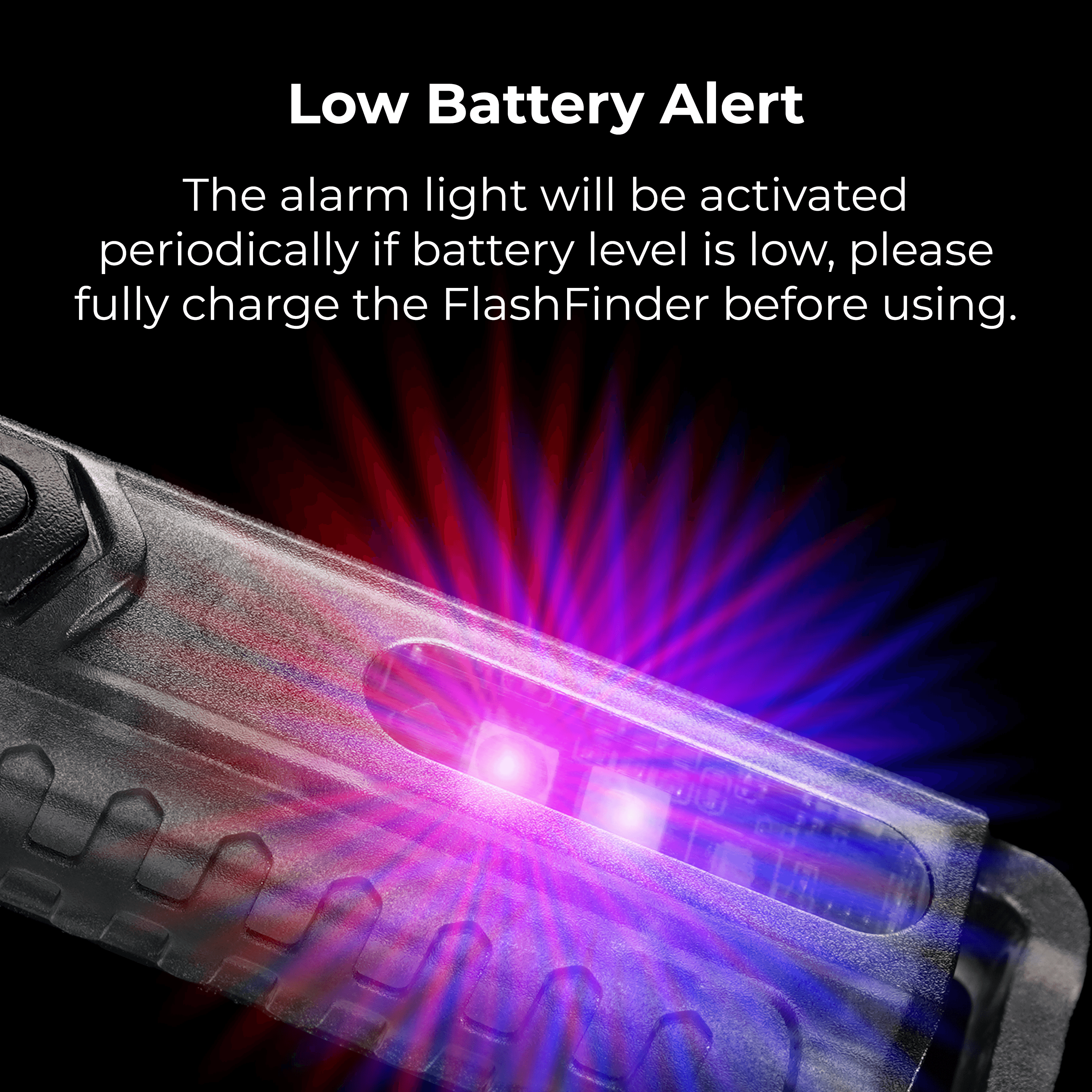
It's a keychain flashlight with Apple Find My built in. 300 lumens — about six times a phone's flash — with a 50 m throw, so it sweeps a lawn or a footwell rather than glowing at your feet. Four lighting modes for normal use, plus six alarm modes with a dual-colour flash when you want to be seen.
USB-C rechargeable, 300 mAh, full charge in 1.5 hours. Months of Find My locating on a charge, and one to six hours of continuous light depending on mode. Nothing to replace and no coin cell dying silently.
The keyring is integrated — no separate holder, no adapter, no extra bulk. A magnetic mount sticks it to any metal surface, so it holds itself against a car body or wheel arch while you use both hands. And it reads as an ordinary keychain flashlight rather than announcing itself as a tracker.
Covered by 9to5Toys, Six Colors, and The Verge's holiday gift guide.
You open Find My. The map says your keys are here. You are standing in here. The keys are nowhere.
This is the most common frustration with item trackers and it isn't a malfunction. It's a structural gap between what tracking networks are good at and what finding an object actually requires — and the gap is roughly the last thirty feet.
What the network can and can't do
Find My works by having nearby Apple devices anonymously report a tag's Bluetooth signal. That's genuinely remarkable at continental scale: your keys can be located in a city you've never visited because strangers' iPhones passed near them.
But that report resolves to an area, not a point. Bluetooth doesn't measure distance precisely, GPS on the reporting device has its own error, and the position you see may be minutes or hours old — the last time any device happened to walk past. In practice a "nearby" pin can mean anywhere in a house, a parking row, or a stretch of trail.
The network is a locator, not a finder. It closes the first mile. It does not close the last thirty feet.
Sound closes some of that gap
The intended fix is Play Sound, and it works fine in a quiet living room. Where it fails is predictable:
Under and inside things. Couch cushions, a car seat crease, a packed bag, coat pockets, a laundry basket. Soft material absorbs high frequencies fast, and a buzzer under a cushion can be nearly inaudible from two metres.
Outdoors. Wind, traffic, and rain destroy a small speaker's range. In a parking lot, sound that carried ten metres indoors carries two.
In the cold. Batteries deliver less current at low temperature and small speakers get quieter — precisely in the season you're most likely to drop keys in a dark driveway.
When you can't localize it. Human hearing is poor at pinpointing a repeating electronic tone in a reverberant space. You can hear that it's somewhere in the garage and still spend five minutes finding it.
When it's dead. A tracker on a coin cell that quietly expired months ago makes no sound and reports nothing.
The five places this actually happens
The scenarios are remarkably consistent, and they share a feature:
The car footwell. Keys slide under the seat into a space with no light and a lot of sound absorption.
Grass, gravel, and snow. A driveway or lawn at night. The keys are within two metres and completely invisible.
Inside a bag. Somewhere in a backpack with eleven pockets.
Behind and under furniture. The gap between the couch and the wall.
The unlit walk itself. Not lost yet — just fumbling for the right key at a dark door, which is how the drop happens in the first place.
Four of five are dark. Three of five are also physically hard to see into. Sound was never going to solve those; you don't need to hear the keys, you need to see them.
What actually closes the last thirty feet
A visual alert on the object. A tracker that flashes rather than only beeping can be seen across a dark lawn from well beyond the distance you'd hear it.
A charge that doesn't quietly expire. Rechargeable beats a coin cell you forget about, because the failure mode of a coin cell is silence with no warning.
Something you'll actually keep on the keychain. The best tracker is the one that isn't in a drawer because it was too bulky or needed a separate holder.
Where FlashFinder fits
We built FlashFinder for exactly this gap — the network gets you close, and the light gets you the rest of the way.
It's a keychain flashlight with Apple Find My built in. 300 lumens — about six times a phone's flash — with a 50 m throw, so it sweeps a lawn or a footwell rather than glowing at your feet. Four lighting modes for normal use, plus six alarm modes with a dual-colour flash when you want to be seen.
USB-C rechargeable, 300 mAh, full charge in 1.5 hours. Months of Find My locating on a charge, and one to six hours of continuous light depending on mode. Nothing to replace and no coin cell dying silently.
The keyring is integrated — no separate holder, no adapter, no extra bulk. A magnetic mount sticks it to any metal surface, so it holds itself against a car body or wheel arch while you use both hands. And it reads as an ordinary keychain flashlight rather than announcing itself as a tracker.
Covered by 9to5Toys, Six Colors, and The Verge's holiday gift guide.
Related Articles
Check out our full product line
Check out our full product line

🇨🇦 A Canadian Company
© 2026 Futura Gear Inc. FTNT, the illustrated FTNT logo, and Footnote Accessories Co. are trademarks of Futura Gear Inc. All rights reserved.
© 2026 Futura Gear Inc. FTNT, the illustrated FTNT logo, and Footnote Accessories Co. are trademarks of Futura Gear Inc. All rights reserved.
🇨🇦 A Canadian Company